Bring me your mind, and I'll pacify it for you!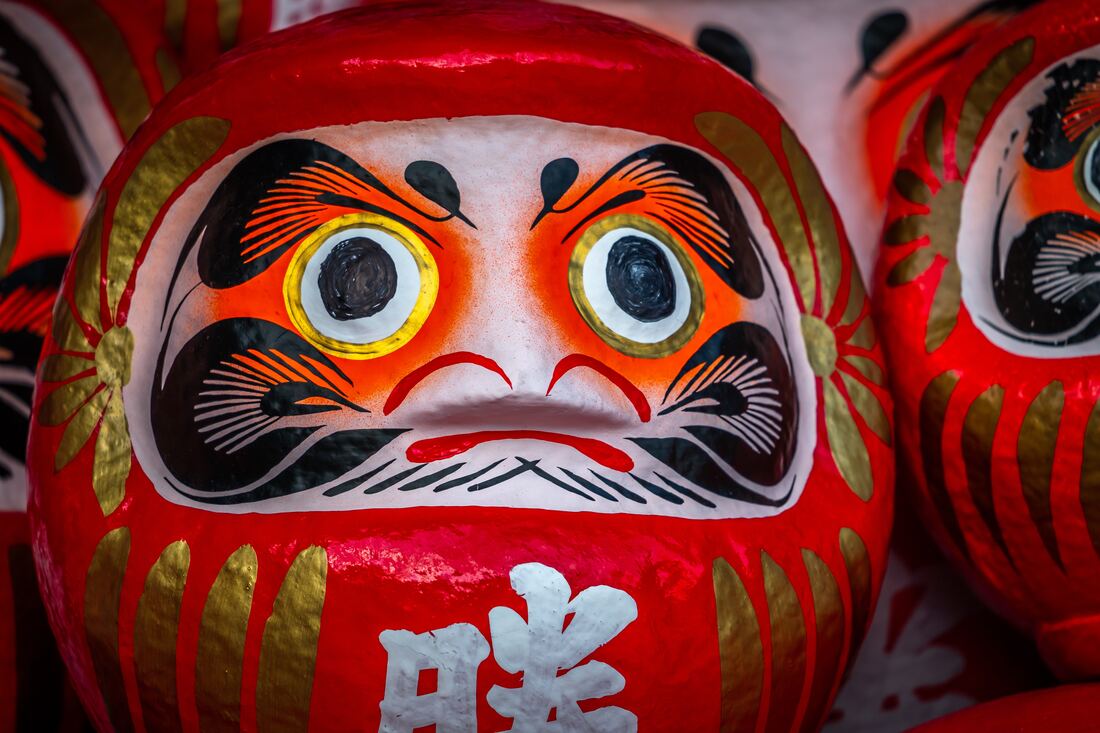
This week we're looking at case 41 in the Gateless Barrier, Pacifying the Mind. Like a number of koans, it reads almost like a joke - there's a 'smart-ass' quality to the master's reply that, on first inspection, makes the whole thing seem like a bit of a game. Nevertheless, this 'so sharp you'll cut yourself' exchange actually conceals a profound truth, one that I'll attempt to point the way to as the article goes on. First, though, let's take a look at this week's cast of characters.
Bodhidharma, the founder of Zen, and Huike, his successor Bodhidharma is generally regarded as a semi-legendary figure these days. He may or may not have existed as a real historical figure, and he probably didn't cross the Yellow River in China on a single blade of grass as the stories tell us he did, but nevertheless he represents the origin of the Zen school of Buddhism. According to the story, Bodhidharma was an Indian (or possibly Persian) Buddhist teacher, who, already advanced in years, decided to travel to China to see how Buddhism was being practised over there. When he arrived, however, he wasn't impressed with what he found. Buddhism in China at the time was a scholarly affair, without much actual meditation practice happening. Disheartened, he retreated to a cave in the Songshan mountains, near the now-famous Shaolin Temple (yes, that one), and sat for nine years facing a wall. (Today, in the Soto style of Zen, the Silent Illumination practice is typically undertaken sitting facing a wall. The nine years of Bodhidharma's retreat have also been symbolically linked to the nine months of pregnancy, and in general there's a sense in Zen that awakening takes time to ripen and mature before it's really 'ready'). The koan begins with Bodhidharma at the end of his nine years of practice. Eventually, some of the monks at the Shaolin Temple started to take an interest in this crazy barbarian hermit living up in the cave, and eventually one named Huike approached him and asked for a teaching. At first, Bodhidharma ignored him, simply continuing to face the wall. This initial refusal to teach a new aspirant is echoed in the ritual that people wishing to become Zen monks must typically go through, where they're initially ignored and left outside the temple gates until they've proven their sincerity by waiting patiently for however long the temple deems necessary. In Huike's case, he settled on a grand - and somewhat horrifying - gesture to show his sincerity - cutting off his own arm. Please don't try this at home! Quite a bit of self-mutilation has been practised in Chinese spiritual circles over the ages - one story about Bodhidharma says that, in order to stop himself falling asleep, he cut off his own eyelids and threw them away; where they fell to the ground, they sprouted into the first tea plants. Another story says that, as a result of his nine-year solitary retreat, he sat for so long that his legs fell off! In Japan today you'll often see 'Daruma dolls' (pictured above), Daruma being the Japanese pronunciation of Bodhidharma's name. These dolls have a round, weighted base to represent a body without legs, as a result of which they roll back upright each time they're pushed over - symbolising Daruma's indefatigable spirit, captured in the popular Japanese phrase 'seven times down, eight times up'. Getting back to Huike and the whole severed arm business, for modern readers it's probably better to interpret Huike's gesture as symbolic rather than literal - a sign of Huike's absolute dedication to take up Zen practice with Bodhidharma. Anyway, eventually, Bodhidharma relented, and turned to face Huike, at which point the exchange described above took place. Commentators often suppose that there's a gap between Bodhidharma's request for Huike to 'bring me your mind' and the next line of dialogue, implying that Huike went away and spent some time searching for his mind, only to discover that he couldn't find it. This seems right to me - maybe I'm just a bit of a slowpoke, but it's always taken me quite a while to find genuine insights! Whether or not this particular exchange led to an awakening for Huike is not recorded in the koan, but Huike went on to be considered Bodhidharma's foremost successor. (Bodhidharma had four students in total - not many for such a pivotal figure! - three men and one woman.) But what does the exchange actually mean, and how can it help us in modern times? Bringing peace to our minds Huike comes to Bodhidharma complaining that his mind is not at peace. This is probably a state of affairs that we can all relate to. But what do we really mean when we say 'My mind is not at peace?' One simple description of what it means to have a mind which is not at peace might be something like: I experience a string of disagreeable thoughts, emotions and other impressions, which I seem to be unable to prevent. (If you have a different definition, let's hear it - please leave a comment down below!) This experience of a seemingly unstoppable stream of unpleasant experiences does seem to be quite common, at least within the self-selecting population of people interested in meditation practice. Quite a few people have come to my Wednesday night class asking how they can 'stop thoughts' because those thoughts cause them so much pain. The usual answer I give is that meditation isn't really about stopping your thoughts - it's about finding a different relationship with them so that they don't cause us to suffer so much. Actually, though, that isn't quite true. If we do a lot of meditation (we're talking many hours a day) with a strong samadhi component, we actually can sometimes enter a peaceful state, initially for short periods, then for longer and longer stretches as our mind settles more and more, until it eventually becomes continuous. This kind of peace of mind can often be glimpsed on longer retreats (a month or more). However, it isn't terribly practical for most of us, since we have jobs, families and responsibilities to fit around the eight or so hours of daily meditation required to maintain this kind of state. So, assuming you don't have unlimited spare time to spend in meditation sufficiently quietening your mind and body in order to be permanently tranquil, what else can you do? The short answer is 'insight practice'. Concentration practice is good at bringing about a change in 'state' - moving us from a more agitated state to a more peaceful one. Insight practice, on the other hand, brings about a change in 'trait' - when we see things deeply enough, we form a new relationship to them, and thus have a permanently different experience as a result. One of the things we can explore in our insight practice is the mind itself - and it turns out that, if we come to understand our minds well enough, then we no longer find the comings and goings within our minds so bothersome. Thoughts and emotions may still come and go, but they lose their sting, and so no longer 'trouble' our minds in the same way. So, what does it mean to 'understand our minds well enough'? What are these insights that practice will somehow give us? Insight practice, the importance of personal experience, and the futility of 'explanations' I've previously written quite a number of articles where I've done my best to provide my own answer to these questions. I've talked about various insights that can come out of Zen practice - into emptiness, non-duality, the nature of mind/awareness, and so forth. But the more I do this, the more I start to question how valuable these kinds of explanations actually are. If you've never eaten a mango, no description of mine will ever convey the experience to you. Maybe I start by saying that it's yellow, and you say 'Oh, so it's like a banana, they're yellow.' Well, no, it isn't like a banana. So maybe I say that, well, no, the texture is more like a melon. 'Ah,' you say, 'it's like a yellow melon. Got it.' Nope, that still isn't right. You can't help but map my words onto experiences that you're already familiar with, because you have no other reference point. But the only experience that's really like eating a mango is, well, eating a damn mango. There's no form of words clever enough to capture that experience for you without you doing the taste test for yourself. My Zen teacher has often commented that Zen seems to attract people who are pretty clever, and I've certainly run into quite a number of people who have read a lot of books about philosophy and science, really thought carefully about them, and can describe a very intellectually convincing model about what's going on both in their own minds and the world around them. Such people often have some kind of objection to Zen practice because they feel that their intellectual understanding of what's going on is 'better' than Zen in some way - more modern, more sophisticated, whatever. It's very difficult to 'persuade' such a person to suspend their well-thought-out philosophy of life in favour of claims which seem to be based in intangible experiences that are not available to the person asking for proof. It's a tough sell. And yet that's how this works. The reason that the old Zen texts (and probably most of these articles) don't make any damn sense at first is because reality isn't what we think it is. We need to engage in long hours of diligent practice to see the truth of these things for ourselves - at which point all of the cryptic writings of the ancient masters (male and female, lay and monastic) start to make sense - because, finally, we've tasted the mango for ourselves, and so we can relate what's being described to our own experience. (This is often a humbling transition. Beforehand, it's easy to think 'Oh, this is all so confusing, why can't they just say it in plain language?' Afterwards, we're forced to admit that, actually, the old masters did a pretty good job.) So rather than attempt to describe what you might find by looking at the experience of a mind not yet at peace, I'll instead simply give you some suggestions for how to investigate it for yourself. In the long run, that's the only thing that will ever make a difference for you personally. (Notice that that's what Bodhidharma does in the koan - he doesn't attempt to explain to Huike why his seemingly troubled mind isn't really a problem, he simply asks Huike to go and find his mind so that he can pacify it. Huike then obligingly undertakes the search for himself.) Some suggested ways to look for your mind Here are three meditative approaches to explore the nature of the mind. Pursue whichever feels more appealing to you - but stick with it. Insights tend to take a while to show up. We can view the practice as a process of gathering evidence which challenges our current world view - we need to get a critical mass of data in order to tip the scales in favour of a new way of seeing things, and that's going to take some time. It can also help very much to spend some time settling the mind with a samadhi practice before engaging in insight work. When the mind is more focused, there's less noise, and more of our being is paying attention to what's going on, so if insights do show up, they tend to go deeper. That's not to say that so-called 'dry insight' (pure insight practice with no samadhi component) doesn't work - but in my experience it's more efficient to spend some time on samadhi first, so that's my recommendation. When your mind is at least a little bit settled - there's often a fairly clear transition where your mind goes from wandering very frequently to being rather more stable - then move into any of the following practices. 1. Silent Illumination In Silent Illumination practice, we simply rest, allowing both body and mind to become still. As the stilling process deepens, the usual noise in our experience quietens down, and subtler aspects reveal themselves to us. This is, by nature, an undirected process, and it can take its sweet time to do anything, but the great benefit is that there's really nothing to remember or do. Just sit there, allowing your body to breathe, and anytime you find yourself doing anything else at all (focusing on something in particular, trying to 'direct' your practice in a certain way, thinking about the practice, etc.), stop doing that. Trust, and see what happens. (If you need instructions for Silent Illumination, you can find them here, and a guided practice on the Audio page.) One key point to note is that the stillness of Silent Illumination will (eventually!) reveal the nature of your mind to you, but the stillness is not the mind itself. What we find in the depths of Silent Illumination practice can eventually be found in every moment of life, no matter what's going on. 2. Koan: 'What, and where, is mind?' Usually I recommend that people interested in koan practice start with 'Who am I?' That will actually get the job done as well. But since today's koan involves Bodhidharma asking Huike to go and fetch his mind, it also works well to use 'What, and where, is mind?' What is it that we're trying to pacify, and where can it be found? As usual when working with a koan, don't try to 'direct' the investigation in any way - just keep asking the question, over and over; notice what comes up, let it go, and repeat. (If you haven't worked with a koan before, you can find instructions here, and a guided 'Who am I?' koan practice on the Audio page.) 3. Direct investigation of the qualities of the mind This third approach is more akin to the sort of thing you might find in the Tibetan Mahamudra tradition. Mahamudra insight practice (vipashyana) commonly involves a long sequence of quite specific investigations, looking at different aspects of the 'mind' (or, synonymously, the 'awareness'). The investigations can seem weird or even silly at first, but there's real power in practising this way, and it's included in today's list because it gives you something a bit more concrete to do than either of the two Zen approaches, which may suit certain types of people better. Some example inquiries:
...And so on. (For a more comprehensive list of inquiries, check out the Mahamudra Meditation Center's Meditation Manual.) One final note - keep going! Insight meditation is a strange business. The practices often come across as weird, trivial or absurd. And yet they work - but only if we stick at it. If your practice is taking you to uncomfortable places then it's very helpful to reach out to a teacher to talk about what's going on, but by far the bigger problem is the boredom and frustration of 'nothing happening'. And yet it's only by crossing the desert that we reach the oasis. So please keep going! And then, when you truly discover your mind for yourself, you can write back to me and tell me how I should have explained it in this article...
0 Comments
The Eightfold Path, part 5
This article is the fifth in an eight-part series on the Eightfold Path, a core teaching from early Buddhism. I introduced the Eightfold Path in the first article in the series, so go back and check that out if you haven't heard of it before. (You can find links to all the articles in this series on the index page in the 'Buddhist theory' section.)
This week we're taking a look at the fifth factor of the path, right livelihood. As you can see from the quotation above, the instruction for this one is pretty simple - just avoid wrong livelihood! But what does that actually mean, and what difference does it make anyway? Let's get into it. What is the 'wrong livelihood' we're supposed to abandon? As you may have noticed, the definition of right livelihood that we find in Samyutta Nikaya 45.8, the discourse that we've been using all the way through this series of articles for the definitions of each aspect of the Eightfold Path, is rather sparse - some might say useless. We're told to abandon 'wrong livelihood', but we had probably already figured that one out given that there's something called 'right livelihood' that we're supposed to be doing instead. If we search around some more in the Pali canon (the collection of discourses from the earliest stratum of the Buddhist teachings), sooner or later we come across Anguttara Nikaya 5.177, which suggests one definition of wrong livelihood: "Monks, a lay follower should not engage in five types of business. Which five? Business in weapons, business in human beings, business in meat, business in intoxicants, and business in poison." This is much more concrete, and thus at first sight appears to be much more helpful. OK, so we're supposed to avoid business in 'weapons' (selling weapons, maybe making them too?), business in 'human beings' (one imagines that this includes things like slavery rather than working in Human Resources), business in 'meat' (fishing, being a butcher?), business in 'intoxicants' (being a drug dealer is off the cards), and business in 'poison' (presumably both poisoning people and selling poison to others is frowned upon). If you've read my previous article on right action and the precepts, however, you'll probably already know that I tend to get a bit suspicious of neat little lists like this. They seem to give a very straightforward answer to our moral questions, but a lot of it comes down to interpretation. While my comment above about Human Resources in relation to 'business in human beings' may have come across as facetious, there's a valid point there. I've lived a pretty sheltered life, but even I've worked for bosses who cared about me and looked out for my interests, and I've also worked for bosses whose only interest was to exploit me for everything I was worth and then throw me aside when I was all used up. Where do we draw the line with 'business in intoxicants' - are we concerned only with certain types of alcohol, or do we include creating apps which are designed to be habit-forming for the purpose of persuading people to part with significant amounts of money through hundreds of microtransactions? Broadening our perspective on right livelihood Let's set the specific list to one side for the moment. What's actually going on here? Why do these categories of 'right livelihood' and 'wrong livelihood' even exist? Right livelihood is part of the section of the Eightfold Path concerned with sīla, or ethics. Fundamentally, all of the ethical teachings demonstrate how the second factor of the path, right intention, is to be practised - in particular, the intention of harmlessness. So we have the third factor, right speech, which points out how easily and immediately we can create harm through our speech, and provides some guidelines for how we can minimise that harm. Next, we have right action, which takes a broader perspective, looking not just at our speech but at our actions more generally, highlighting how we might cause harm through taking life, taking what is not given, or engaging in sexual misconduct. Finally, we arrive at right livelihood, which takes a broader perspective still, looking at the type of life we lead. Our livelihood matters because it shapes so much of what we do - particularly if we broaden our sense of 'livelihood' to include 'lifestyle' rather than simply 'occupation'. Our lifestyle governs to a significant degree the types of situations we end up in - and thus some lifestyles are much more conducive to right speech and right action than others. A career criminal is very likely to have to tell lies (wrong speech) and take what is not given (wrong action) as a matter of course. Even leaving aside the harm that comes from such a lifestyle, being in this kind of life situation is very unlikely to lead to a peaceful mind which is well suited to meditation practice. So I'm going to suggest that the most useful questions to ask ourselves in relation to right livelihood are not 'Is my occupation on the naughty list?', but rather 'How do I make my way through the world? What are the positive and negative aspects of my lifestyle? What effect does my lifestyle have on my state of mind? And, once I've really spent some time with this and come to a balanced assessment, how should I move forward?' This kind of close examination of our lifestyle isn't necessarily a practice that needs to be undertaken every day - that could lead to endless second-guessing and self-paralysis - but it's definitely useful to go into great detail at least once, and then check in every so often (maybe every couple of years, or after a major life change) to see how things are going. Our lifestyles tend to drift rather slowly, usually too slowly to notice it happening in real time, so checking in every once in a while gives us the opportunity to notice how things might have drifted over the months and years. Practice and life The inclusion of right livelihood in the Eightfold Path really helps to highlight that, for the Buddha, 'practice' and 'life' were synonymous. For many of us, it's easy to relate to 'meditation' as just one of a wide range of activities in our busy lives, twenty minutes a day of self-care that we can treat a bit like going to the gym - we know we're better for doing it, but we leave the weights in the gym at the end of a session and forget about them until next time. This is actually fine so far as it goes, and I don't mean to criticise anyone who has this kind of relationship to their meditation practice! I used to feel that way too, actually. For me, though, as my practice has gone deeper, I've started to notice more and more ways that my meditation practice and my life overlap. Insights that come up in meditation can often be applied to life situations - and conversely. (The model of 'excitation and stimulation' that I described in a recent article was something I first noticed as a result of looking at stress in my working life and experimenting with different strategies to manage it, not something that was directly related to meditation practice.) In the Zen tradition, there's a strong sense that practice can be continuous - not limited to any particular time of day or posture, but rather an attitude of presence that is carried throughout all of the activities of the day. When we have work to do, we can apply ourselves wholeheartedly to it, focusing wholly on the task at hand. When we have a quiet moment, we can return to meditation, or simply rest in the present moment rather than letting our thoughts spin out into planning tomorrow's meeting for the seventeenth time. As we do this, we start to feel the boundaries between 'practice' and 'life' dissolving. Meditation becomes more 'ordinary' and life becomes more 'extraordinary'. We discover that we can walk the spiritual path not in order to get to some special destination, but simply because walking the path is a good way to live. May your practice (and your life) go well. Making sense of a world in which nothing is as it seems
This week we're looking at case 40 in the Gateless Barrier, 'Kicking Over a Water Pitcher'. This rather peculiar story starts with Zen master Baizhang (last seen all the way back in case 2) asking a typically incomprehensible question, followed by equally bizarre answers. What's going on here?
Before we get into that in detail, let's go on a brief digression. It'll be relevant later, I promise. How I became a recovering perfectionist The seeds of my perfectionism were planted early. As a young'un I was academically gifted; my mum liked to see me do well, and my dad liked to needle people to wind them up ('Oh, 9 out of 10? Which one did you get wrong then?'), so I tended to set my sights pretty high (and avoid situations that would show me up to be less than perfect - not a great recipe for growth, but there you go). Over the last decade or so of practice, that sense of perfectionism has gradually started to erode. Several factors have played into that. The lack of a clear external metric (marks out of 10) has been a big one, but somehow I still managed to hold on to an ideal of perfection for quite a while despite that. Then, in the last couple of years, as I've been confronting my tendency to apply too much effort to my meditation practice (see last week's article!), I've experimented with flipping from 'perfect' to 'good enough' as my ideal. But that just replaces one problem with another - what's 'good enough'? This turns out to be a matter of perspective and context, rather than something that can ever be pinned down. To paraphrase a line from the Zhuangzi, if we say that something is good because it is praised by someone, then everything is good; if we say that something is bad beacuse it is criticised by someone, then everything is bad. Let's take playing the piano as an example - this is something that I used to do (sadly I don't really have time any more). How good is 'good enough'? Well, it turns out that, no matter your level of skill, there will be some pieces of music that you can play easily (everyone can play a middle C if the right key is pointed out to them!), some which you can't play at all, and some which are right on the limit of your current level of skill. So you're 'good enough' to play the easy ones, need to get just a little better to play the ones that are right on the edge of your skill, and are not 'good enough' to play much more difficult pieces. The tricky bit is that it's easy to look at what we can't do and say 'Oh, I'm not good enough yet, I can't do xyz' - but that will always be the case. Many of the musicians who are regarded as the greatest in their field will comment in interviews that they're always practising, trying to get better, trying to reach some higher standard that feels forever beyond them. To be clear, it isn't that it's a bad thing to want to improve! But if we're constantly beating ourselves up for not being 'good enough', then it may be helpful for us to investigate that notion to find out what it means to us. As we do that, we'll discover that it's much more of a moving target than we might have thought - and so our continual failure to achieve the satisfaction we thought we would find at the end of it all suddenly makes a lot more sense. How does this relate to the koan? What I've just described is one version of what's known as 'emptiness' in Zen. This slippery notion is all to do with pointing out how our concepts don't quite fit reality. We start with something simple like 'It needs to be perfect!' - that's a nice, apparently clear-cut target to aim for. Yet it turns out to be unreachable, again and again, and to the extent that we continue to cling to that idea of 'perfection', we suffer as a consequence of our failure to attain it. But then, through meditation and investigation of our experience, we realise that we've been chasing a pot of gold at the end of a rainbow - it's an optical illusion, something that doesn't really exist. And so we're able to relax and let go of the impossible goal, and the suffering that comes with it. Seeing emptiness for ourselves (through a koan or Silent Illumination) is a major landmark on the path of Zen. It's a turning point, a point of no return - having seen the emptiness of the world, you can't ever go back to believing in a fully dependable, predictable world any more. And yet that isn't the end of the road by any means - in many ways it's more of a beginning. As our understanding of emptiness deepens, we begin to notice more and more ways in which it applies to our experience. It turns out that all of our concepts are empty (including emptiness itself, but that's a head-scratcher for another day!). This can be very liberating, because all of a sudden the seemingly impenetrable walls keeping us trapped inside our suffering are revealed to be totally illusory. On the other hand, it can also be pretty confusing, as the seemingly dependable pillars of our life now appear to be shaky, impermanent and context-dependent. It's as if we've lived our whole lives with a road map which was beautifully clear but seriously misleading - we can no longer trust the road map any more, but then how are we going to get from A to B? How can we navigate at all in an empty world in which nothing is certain? And that's what Zen master Baizhang is asking in this koan. He picks up a water pitcher - we know what a water pitcher is, you put water in it and you pour the water out when you want a drink. And yet we can assume that both Guishan and the leader of the assembly have done enough Zen practice to realise that the label 'water pitcher' doesn't fully capture what's going on here - it's just a limited concept, as empty as anything else. So if you can't call it a water pitcher, what do you call it? What is a river? Another example may help to clarify what's going on, at least at the intellectual level. (Intellectual understanding doesn't go far enough, but it's the best I can offer in an article! In time, your Zen practice will reveal emptiness to you on an experiential level, which is where it really makes a difference in your life.) What's a river? Perhaps this seems like a daft question - everyone knows what a river is. It's when you've got a bunch of water flowing from somewhere upstream to somewhere downstream, probably ultimately ending up in the sea. What's hard about that? OK, but what actually is the river? Is it the water? Presumably not, because the water is constantly flowing - if you stand and watch a river, you're seeing new water every moment. What else is involved? Well, there's a channel carved into the earth which makes the water flow in a particular direction, starting at a particular place and ending somewhere else. That's pretty important too - different rivers have different names, and if you're planning to go boating with friends it matters whether you're meeting on the River Severn or the River Thames. But, then again, the course of the river changes from time to time - if it's rained a lot, it might flood, or a shallower side channel might dry up entirely. And over a much longer period of time, the flowing water erodes the earth forming the river channel, causing it to change shape and direction. Sometimes a river can be diverted, either intentionally or unintentionally, so even the point where it reaches the sea can change significantly. And yet we still consider it to be 'the same river', even though pretty much every observable characteristic of it changes over time. So why does this work? Because, in general, the changes to the river are small enough that they don't make much practical difference. Some days the brook behind my house is barely a trickle, some days it's a pretty strong flow, but either way there's usually some water down there - enough for the neighbourhood dogs to jump into and splash around in, anyway. Yes, it's much more of a process than a thing, but the process is consistent enough that it's sometimes useful to be able to label it and refer to it, even though the label doesn't refer to anything totally objectively real or dependable in any absolute sense. Getting back to the road map analogy, perhaps we started out believing that we had access to satellite imagery which mapped out the terrain perfectly; then, when we discovered that the map wasn't perfectly accurate after all, we experienced a period of disorientation, not knowing how to move forward now that we felt we could no longer trust the map. But then, as our understanding of emptiness deepens, we realise that we're dealing with something more like the London Underground map. We can't take it too literally, but once we understand how it works, we can still use it to get around - and that's much better than not having a map at all! The two answers Coming back to the koan, we can perhaps now understand what's going on with the two responses to Baizhang's question. The leader of the assembly (presumably the head monk at the temple) says 'It cannot be called a tree stump.' (As an aside, this is my own choice of terminology - one version I've seen says 'It cannot be called a wooden upright bolt', but I don't even know what a wooden upright bolt is(!), and another says 'It cannot be called a stump', which it take to mean a tree stump rather than a severed limb, hence my choice of translation.) This seems like a pretty random answer at first sight, but what he's saying is 'Just because it's empty doesn't mean that you can use any old label to describe it! Some labels are more useful than others. It's much more useful to think of it as a water pitcher than as a tree stump, for example - neither is "ultimately true" but one fits the observed phenomenon a lot better than the other.' This is an important point, and it's a bit of a relief for anyone who's been wondering how on earth they'll ever able to have a normal conversation with someone else after realising emptiness for themselves. It's fine - you can still use all the same words you always have. The difference is that you now know there's more to it than that - and that, if any of those words are taken too seriously and clung to, that's a setup for suffering. Instead, we simply take up the words as we need to, use them for the time being, and then put them down again when they've served their purpose. So, actually, although the monk 'loses' the competition, he gives a pretty good answer! However, he's pipped the post by Guishan, who simply kicks over the pitcher and walks away. Guishan is making the same point, but much more directly. Whatever you choose to call it - a pitcher, a jug, a container of water - its behaviour is the same. If you want it to hold water, it needs to be upright. If you knock it over, the water spills out and makes a big mess. In the Zen tradition, answering a question through action is typically regarded as better than answering through words. Words can sometimes be helpful, but often can indicate that one's understanding only goes to the intellectual level. One can 'talk a good game', but if an insight hasn't yet reached the deeper levels of our being, it hasn't changed our lives. When an insight goes deeply enough, it's expressed in our actions, not just in our words - what's referred to as 'bodily attainment' in the Zen tradition. That's when it's truly useful - when it's so integrated into our being that no thought is required, no reflection, no debate - we simply act in accordance with the Great Way, without having to think about it at all. And so, by responding with an action rather than words, Guishan demonstrates the depth of his understanding - and his readiness to embody the path for others, not merely to talk about it. May you, too, come to embody the Great Way of Zen through your practice. Understanding excitation and stimulation in practice I'm writing this on the penultimate day of a jhana retreat that my teacher Leigh Brasington and I have been running through Gaia House. Over the course of the retreat I've been noticing patterns in the challenges that come up in regard to settling the mind sufficiently for the jhanas to become available, and so I'm going to share a model that I use to understand what's going on here.
(While the article will be focusing on concentration/samadhi practice, I think the model actually works for any form of practice, or even any activity in general - I first started to notice this phenomenon in another context entirely. So even if samadhi isn't your bag, it might still be worth a read.) Excitation and stimulation There are two key aspects which come together in any meditation practice. For want of a better term (if you can think of better words, please suggest them!) I'm going to call them 'excitation' and 'stimulation'. Excitation is a measure of how 'activated' we're feeling at the time. If you're having a stressful time at work, your level of excitation is likely to be pretty high. If you're several days into a relaxing holiday, your level of excitation is going to be much lower. In a nutshell, excitation is a measure of how 'shaken up' we are inside (in the sense of shaking up a Coke bottle). In other words, excitation relates to you, the meditator, and the inner condition that you're bringing to the present moment. It runs on a continuum from 'peaceful' (low excitation) to 'excited' or 'stressed' (high excitation, depending on whether positive or negative in nature). Stimulation is a measure of how 'interesting' the current external situation is - whether that's the meditation object you're working with, or anything else. Going to a rock concert is very stimulating, sitting silently in an empty room facing a blank wall is not at all stimulating. Stimulation thus also runs on a continuum from 'subtle' (low stimulation) to 'intense' (high stimulation). So excitation represents your inner condition, while stimulation represents the outer condition. The coming together of the two is the present moment. Why does this matter? Because it's much easier for the mind to engage with something that's stimulating enough but not too much. If you're in a highly excited state and you try to move straight into a very subtle practice, it'll feel 'boring', and the mind won't want to stay there. By comparison, if you're in a very quiet, peaceful state, you may find a rock concert to be overwhelming - just too much to handle right now. Compensating for a mismatch of excitation and stimulation with effort It's very common for people to come on a jhana retreat and have a hard time at first. They're arriving from jobs, families, travel, all sorts of highly stimulating things, and so they're showing up with a fairly high level of excitation. Then we tell them to pay attention to the sensations of the breath, and do nothing else until the mind stops wandering, at which point they might be able to start trying to get into the jhanas. So they're coming from a place of high excitation, being offered something that sounds very cool (these altered states of consciousness called jhanas) - and then being asked to do something which, relative to the moment, is extremely boring, yet somehow they have to find a way to get through it to get to the cool thing on the other side that they're here to learn. Needless to say, this can be a recipe for frustration. A very common response to that sense of frustration is to apply more effort. 'OK, my mind is wandering, but I can't get into the first jhana until it calms down, so I'm damn well going to make sure it stays put!' Sometimes this is even consciously expressed, more often it's an unconscious manifestation of the practitioner's sincere wish to enter the jhana. (As an aside, this is why the jhanas get a bad rap sometimes, because detractors will say 'Oh, that's just craving, it's unhelpful, don't do it.' But the jhanas are a powerful asset on the spiritual path, and in my view there's nothing wrong with wanting to learn a skill which will help someone in their practice. Yes, any craving that's present will need to be addressed, but the 'nice' thing about the jhanas is that you can't get in if you're craving too much, so that has a way of working itself out through practice.) So does it work? Can we 'nail our attention to the breath'? The answer is... kinda, but you probably shouldn't, and if you overdo it, it won't work at all. Using a totally unscientific numbering scheme for effort, where 5 is maximum effort and 0 means you didn't even sign up for the retreat, we see this sort of thing: 5: Tight mind, no possibility of progress Just as the body has a stretch reflex that kicks in when it feels it's in danger of being over-stretched to the point of injury (which is why we generally have to stretch gently if we want the body to open up), it seems that there comes a point where the mind is being pushed too far and it refuses to cooperate any longer. The mind becomes very tight, useless for concentration or meditation of any kind, and it generally feels pretty crappy to boot. When the mind has reached this stage, the only thing to do is to step away from the practice for a while. Go for a walk, take a break, do something else for a bit until you can relax internally. 4: Unpleasant glass ceiling A lot of effort actually can take you some of the way - but usually it only goes so far. A lot of people find that they can get 'kinda concentrated', but not enough so to get into the jhanas. They'll arrive at a place of indistractibility, maybe even feel a sense of the body's energy (piti, see this page for more details) starting to gather, but it never really takes off. This is a really frustrating place to be, and it's very natural to feel that just a little more effort will surely tip it over the edge - but just a little more effort is going in exactly the wrong direction. 3: Workable concentration with unpleasant side effects At the next stage, the mind is loose and mobile enough that it's possible to get concentrated and even enter the jhanas. However, it's unlikely to be the uncomplicated experience of bodily bliss and emotional joy that's described in the suttas. Instead, people will report strange muscle tensions, headaches and other unpleasant side effects. I can relate to this very much. Historically, I've never been much of a 'middle ground' kind of person. Fortunately I wasn't at effort level 5 when I went on my first jhana retreat (that would come later, but that's a story for another day!), but I started out squarely at level 4. Fortunately I was able to chill out enough to get down to level 3, at which point jhanas started to happen - and so I stayed at that level for many years, basically doing my best to ignore the unpleasant side effects for as long as I could. These days the overall tone of my practice is much gentler, but because of the way I learnt the jhanas, I still find that doing a lot of jhana practice can trigger that more effortful mode of practising quite easily, so I have to keep an eye out for that. 2: Balance. Concentration develops in its own time, without being forced This is where we want to be - just enough effort to keep the practice moving forward, not enough to cause ourselves problems. My sense is that 'level 2' is actually a pretty broad category, with some people more at the 'just let it happen' end of the scale while others are more 'on it'. Essentially what we're looking for here is the balance that Leigh calls 'relaxed diligence'. 1: Wandering, drifting, practice not firmly established I'm mainly focusing on too much effort in this article, but of course the equal and opposite error is not to bring enough effort to the practice. You've got to do the work - it isn't enough to come on retreat and then spend the time 'goofing off', as Leigh would put it. If the retreat is turning into more of a holiday, the 'diligence' part might be lacking. It's always a shame when this happens, because clearly the person was interested enough to sign up for the retreat in the first place (and take a space away from someone else!). (In case anyone from the present retreat is reading this, I'm not talking about anyone in particular here! I don't think anyone on this retreat has been goofing off - on the contrary, you've all done really well in the circumstances you've been working with, and it's been a pleasure to practise with you all.) So if more effort isn't the answer, what is? Coming back to the 'excitation' and 'stimulation' model, we still have this problem that you may be coming into your practice in a highly 'excited' state, relative to which a meditation practice like noticing the breath is much too subtle to hold your interest - as a result, the practice is boring, your mind wanders, and nothing much happens. What can we do about this? In a retreat context, the problem will actually often 'solve itself' after a few days. When you're on retreat (particularly a residential retreat), you've removed yourself from most of the sources of stimulation that are present in your daily life. Just like a snow-globe is busy right after you've shaken it up but gradually settles down if you just leave it alone, your mind and body will gradually settle (i.e. your excitation level will decrease), and eventually you'll arrive at a place where the breath is a more accessible object. The breath hasn't become any more stimulating than it was, but because you're now less excited, the breath appears more interesting than it did. This solution has some appealing qualities, particularly if you're prone to over-efforting. Going on a retreat knowing that your first few days will be spent settling down, and all you have to do is to allow that process to happen, can really help to create an attitude of openness rather than one of forcing. The drawback is that you're still working with a 'too boring' object for those first few days, which can potentially trigger frustration and restlessness, slowing down that process of settling. An alternative is to vary the meditation practice over time. Leigh and I will offer a variety of 'aids' to settling the mind for people who have chosen to work with the breath as a means of settling the mind - for example, counting the breaths, visualising an ocean wave coming in and out with the breath, using a mantra in time with the breath, noticing the parts of the breath (beginning, middle, end, gap) or noticing the lengths of each breath (shorter than average, longer than average? shorter than the last, longer than the last?). Other teachers have suggested a wide range of similar approaches - imagining that you're breathing in a pleasant scent, feeling the movement of breath as a pleasurable sensation, relating to the breath as the breath of Buddha, all sorts of different ideas. What all of these have in common is that the breath goes from the very subtle, very unstimulating 'in, out, in, out' to an experience which is richer and more engaging. As a result, people generally find it easier to rest the mind on this more highly stimulating object. The drawback is that, because the object is now more stimulating, it may limit how calm the mind can become. What was initially perceived as interesting can start to become irritating, noisy, 'too busy'. At this point, if the meditator moves to a less stimulating version of the object - for example, if they've been counting each in-breath and out-breath, shifting to just counting out-breaths, or even dropping the count entirely - then the mind can settle even more deeply. There's sometimes a moment of instability and disorientation, because some of the landmarks of the previous stage of practice have now gone away, but the mind typically settles down again and now goes deeper. Developing sensitivity to excitation and stimulation Perhaps the trickiest aspect of all this is that our excitation levels can be unpredictable, even on a retreat. While the overall trend on a retreat for most people is towards gradually decreasing excitation of mind and thus gradually deepening subtlety of object, it can vary day by day, or according to time of day (my mind is busier in the mornings and quieter in the afternoons), or even from one sit to the next (a 'good' sit will often lead to a more distracted next sit because the excitation level has risen). While I have a deep appreciation for the simplicity and profundity of the 'just let it happen' approach to practice, I do think that there's great benefit to be had from developing an awareness of our internal condition and a sensitivity to how that condition is interfacing with the stimulation offered by the practice we're working with, and learning how to tweak the practice to meet ourselves where we are rather than where we'd like to be. Over time this will start to happen intuitively, and will need less and less conscious attention and intervention - you'll just start to feel 'Oh, needs a few more details right now to stay with it' or 'Ahh, mind getting settled - relax, simplify'. I hope these reflections prove helpful in your meditation practice. The Eightfold Path, part 4
This article is the fourth in an eight-part series on the Eightfold Path, a core teaching from early Buddhism. I introduced the Eightfold Path in the first article in the series, so go back and check that out if you haven't heard of it before. (You can find links to all the articles in this series on the index page in the 'Buddhist theory' section.)
This week we're going to take a look at the fourth aspect of the path: right action. Like the third aspect of the path, right speech, right action is part of the section on sila, or ethics - essentially, practices relating to how to live in the world in a way which minimises the harm we do to ourselves and others. I've already talked about the value of Buddhism's ethical teachings in the article on right speech, so I won't repeat that here - check that article out if you're curious. So what is right action? I've taken the quotation at the top of this article, which defines right action in terms of three factors (refraining from killing, stealing and sexual misconduct), from Samyutta Nikaya 45.8 for consistency with the other articles in this series. However, it's more common to find right action equated with the Buddhist precepts, of which there are five for householders and many more for monks and nuns - this includes the three listed above, plus precepts concerning lying and (ab)using intoxicants. The version of the precepts that I use when teaching retreats runs as follows:
These are pretty simple, pithy and easy to remember. That said, I'm also a fan of the version of the precepts given in the Brahmajala Sutra from the Mahayana tradition, precisely because what's given there is not short, pithy and straightforward - it's actually pretty complex. I like more complex takes on the precepts because the key word in the definitions I gave above is training. The precepts are not 'Buddhist commandments' phrased as 'thou shalt not' - like every other aspect of the Eightfold Path, they're intended as practices, something that we actually explore for ourselves rather than simply memorise and then repeat on command. Indeed, one of the signs of the first stage of awakening in the traditional model is that we are no longer bound by the fetter of 'rites, rituals and righteousness' - which means that it's clear that merely behaving a certain way because someone else told us to is not the way to awakening. Rather, our relationship with the precepts becomes a living exploration, more of a dance than a rigid, legalistic submission to an arbitrary set of rules. With that in mind, I'm not going to write a huge article telling you what I think about each of the precepts. Rather, I'm going to present a contemplation practice which invites you to explore each precept for yourself. Contemplation versus meditation Contemplation is similar to meditation, but with a slightly different orientation. Contemplation can feel a bit weird the first time you try it because it seems to be 'breaking the rules' of meditation. Typically speaking, in a meditation practice we're not really that interested in the content of our thoughts - we might be focused on the physical sensations of our breath, or the visual appearance of a candle flame; if we're doing something like Zen koan practice or the Brahmaviharas, we may be using words as part of the practice, but the idea is that the words support a focus on something else (a feeling of questioning in koan practice, an emotion in Brahmavihara practice). By comparison, in contemplation, anything goes. In a contemplation practice we'll have some kind of theme that we're investigating - but how we investigate it is completely up to us. You're welcome to think about the theme as much as you like - but you're equally welcome to work with it like a koan (bringing up the theme from time to time to see what it stirs up), or simply to set the intention to explore the theme and then just sit and see what happens. I typically suggest taking some time to settle your mind through meditation, perhaps by paying attention to your breath or doing a bit of loving kindness practice. Then, when the usual whirl of everyday thoughts has settled down a little, shift over to the contemplation. I'll now suggest a contemplation on the precepts. For each of the five, I'll give the headline statement, then suggest a few 'probes' - particular lines of inquiry that you can introduce to explore different aspects of the precepts. You're entirely welcome to use these just as much or as little as you'd like. These are some 'ways in' that I've found helpful for myself, but each of us must ultimately find our own relationship to the precepts. Trigger warning, and how to approach this practice This is not lightweight stuff - exploring the precepts seriously can take you to some dark places. Please be kind to yourself. Please note also that some of the 'probes' below are deliberately provocative. I am not advocating any kind of unethical action, even as an 'experiment'. Furthermore, please don't use this as an exercise in self-judgement or criticism. The point here is not to beat yourself up for what you perceive as your ethical failings. The point is to explore the precepts to get a feel for what they mean to us on a visceral level, to encourage us to engage with the material rather than simply treating it as yet another set of 'laws' handed down through the generations. OK, without further ado, let's get into it. A contemplation on the precepts
Take at least a few minutes just to sit quietly, perhaps focusing on the breath or doing metta, in order to settle your mind before proceeding. Then, when you're ready, start moving through the contemplations below.
Take some time to explore this precept in the broadest sense. Taking life could potentially include everything from killing another human, to stepping on an insect, to taking antibiotics, to cutting down a tree. What does 'taking life' mean to you? How do you feel when you see or hear about life being taken? Does it make a difference what kind of life is being taken, by whom, or for what reason? When is the taking of life justified? What might it mean for you to undertake the training to refrain from taking life?
Take some time to explore this precept in the broadest sense. Taking what is not given could potentially include everything from armed robbery, to insider trading, to shoplifting, to taking more than your fair share, to watching copyrighted videos on YouTube, to taking up too much of someone else's time and energy. What does 'taking what is not given' mean to you? How do you feel when you see or hear about someone taking what is not given? Does it make a difference what is being taken, by whom, or for what reason? When is taking what is not given justified? What might it mean for you to undertake the training to refrain from taking what is not given?
Take some time to explore this precept in the broadest sense. Sexual misconduct could potentially include everything from rape, to inappropriate physical contact, to adultery, to using sexuality to get what you want. What does 'sexual misconduct' mean to you? How do you feel when you see or hear about someone committing sexual misconduct? Does it make a difference what kind of sexual misconduct is being committed, by whom, or for what reason? When is sexual misconduct justified? What might it mean for you to undertake the training to refrain from sexual misconduct?
Take some time to explore this precept in the broadest sense. False speech could potentially include everything from lying under oath, to committing fraud, to spreading lies about someone to damage their reputation, to misleading someone in order to manipulate them, to exaggerating your achievements to make yourself sound more impressive, to telling a little white lie for social convenience. What does 'false speech' mean to you? How do you feel when you see or hear about someone speaking falsely? Does it make a difference what kind of false speech it is, by whom, or for what reason? When is false speech justified? What might it mean for you to undertake the training to refrain from false speech?
Take some time to explore this precept in the broadest sense. Intoxicants could potentially include everything from alcohol, to recreational drugs, to risk-taking behaviour, to anything else we can get addicted to - gambling, the Internet, even our work. Heedlessness could potentially include anything from total loss of control, to a significant impairment of judgement, to a subtle lowering of inhibitions. What does 'intoxicants causing heedlessness' mean to you? How do you feel when you see or hear about someone using intoxicants leading to heedlessness? Does it make a difference what kind of intoxicant it is, or what degree of heedlessness? Does it make a difference by whom, or for what reason? When is the use of intoxicants leading to heedlessness justified? What might it mean for you to undertake the training to refrain from intoxicants causing heedlessness?
It's likely that the contemplations above have brought up quite a bit of material. I suggest closing the practice by taking a few minutes for meditation to let things settle down again - perhaps returning to the breath, or metta, or just sitting. May you be well. How to get free of the tangle
This week we're looking at case 39 in the Gateless Barrier. This is a rich koan offering many possible avenues of exploration; I won't have time to explore them all in today's article, even assuming I've noticed all the possibilities, which I probably haven't! But we'll dig into a few and see where they take us - and if you find another thread to pull on, please go right ahead (and let me know what you've found in the comments!).
The central question here is that of Zen master Sixin (pronounced something like see-shin) - where did the monk get trapped in words? Here are three possibilities, representing progressively deepening levels of realisation. The monk became trapped in words when he read Zhang Zhuo's poem Sometimes, we come across a passage in a Zen text or poem (or some other spiritual, philosophical, literary or scientific work) that stops us in our tracks. Perhaps it conjures up a picture of something that feels both deeply familiar and utterly mysterious at the same time - or perhaps it just makes no sense at all, and yet somehow we have an intuition that it isn't mere nonsense. Naturally, we want to know what it means - but we can't relate to it directly and immediately, so all we have is this mysterious set of words. From a Zen perspective, this is actually a good place to be. What we have in moments like these is a kernel of what's usually known as 'Great Doubt' in the Zen tradition, although teachers like Martine Batchelor have argued that 'Great Questioning' might be a better translation due to the negative connotations of 'Doubt' in the English language. Essentially, what we've found is something we don't understand and would like to. That is the essence of all meditative inquiry, and is the necessary condition for insight to arise. If we 'do insight practice' but have no interest in what we might find, if we already feel that we've got it all worked out and this meditation stuff can't possibly show us anything new, then it's dramatically less likely that we'll make any meaningful progress along the wisdom dimension - and if we do somehow get a breakthrough nonetheless, it's likely to be jarring, upsetting, even distressing, as the comfortable world we were clinging to is turned upside down. By comparison, if we actively choose to undertake the quest for greater wisdom, we're more likely to hang in there when the going gets tough, because on the other side of that bumpy terrain is a place we're trying to get to. Seen from this perspective, we could make the case that the entire purpose of koans is for us to get caught in words - to find one of these strange stories that intrigues us enough that we're willing to spend hours on the cushion studying them in meditation, often getting absolutely nowhere for hours, days, weeks or months on end, until one day - boom, there it is. So it could well be that this nameless monk has simply read a piece of poetry, been struck by the beautiful images it conjures up, and wants to ask his teacher something like 'What's it like to experience this for yourself? How do I get there?' In this reading, Yunmen's response is sharp but compassionate, directing the monk to put the books down and get back to practising - in essence, saying 'Don't ask me, ask yourself!' The word 'Zen' literally means 'meditation', and the essential principle behind the Zen school of Buddhism is to use meditation to find the answers we're looking for in our direct experience, rather than debating theories and philosophies in an intellectual way. It's possible to spend many years - even a lifetime - arguing about the fine scholarly points of non-duality and emptiness without ever having a personal experience of it, and so Yunmen is deeply concerned that the monk should not make this mistake. Words like these - the kind that describe the experience of someone who has broken through to the awakened perspective - are actually often more helpful after one's awakening than before; before awakening, they're at best a cryptic riddle that can inspire us to practise, but after we've had a glimpse of awakening, we can use them to confirm what we've experienced - or, more usually, to recognise that what we saw was only partial, and that there's further to go. The monk became trapped in words when asking Yunmen his question A second possible scenario is that the monk had indeed had some kind of awakening, or perhaps was right on the threshold of it, but couldn't put it into his own words. In the words of Zen master Wumen, the compiler of the Gateless Barrier, 'In a natural manner, inside and outside become one; like someone without the power of speech who has had a dream, you can know it only for yourself.' Having this kind of 'private' experience can be beautiful and thrilling, but it's also limited. One of the strengths of the Breakthrough to Zen retreats run by Zenways, the Zen sangha I belong to, is that most of the practice happens out loud, with a partner in front of you. Whatever's going on, you must try, over and over, to put it into words. In the process of doing so, it both comes out into the world and becomes more fully your own. At the very beginning of this process, it's often clumsy, and you may find yourself resorting to lines from the old masters which you feel capture the spirit of what's going on. But in the long run, the language must become your own, the awakening fully integrated into your being, not someone else's. And so perhaps that's what's happening here. The monk has had some kind of experience, but has no words for it. The best he can do is to say 'It's like radiant light was silently illuminating the whole world...' - and his teacher is challenging him to put down the books and find his own words for it. In part, this might be a test - anyone can quote one of the old masters, but it's usually very revealing to hear someone's first person experience in their own words rather than those of another. From the teacher's standpoint, this is a key 'diagnostic' technique - all sorts of interesting and wonderful things can happen in meditation, not all of which are due to insight or awakening, and so it's usually necessary to spend a bit of time talking back and forth to figure out what's going on. The monk became trapped in words when Yunmen interrupted him A third possibility is that the monk has indeed had some experience of awakening, and is now some way along the road to stabilising and integrating it. Sometimes it's thought that enlightenment happens all at once, in a flash - bam, that's it, you're enlightened now. The stories of the historical Buddha usually imply that that's how it was for him. For most of us, however, it isn't quite so simple - and even the historical Buddha went on to teach a model with four 'stages' or 'paths' of awakening, gradually deepening over time. Likewise, one of the most important Zen masters in my lineage, Hakuin, taught at great length about the importance of 'post-satori training' - that practice does not end with a meditative breakthrough, but actually that that breakthrough is simply a transition from one phase of practice to another. Now, this is a somewhat controversial subject, and there have been debates throughout the history of Zen. From a certain point of view - what we might call the standpoint of 'inherent awakening' or 'Buddha Nature' - what we wake up to is immediate, timeless, and has always been true. Nothing needs to be 'cultivated', nothing needs to be 'purified', it only needs to be recognised for what it is, in all its immediate, pristine, indestructible purity. This is the so-called 'sudden' school of awakening. From another point of view, however, practice is clearly necessary - although we may well possess the seed of awakening within ourselves, for most of us it isn't yet fully flourishing - if it were, there would be no need for Zen at all. And so we undertake this practice, meditating, cultivating mindfulness in our daily lives, exploring both inwardly and outwardly, and over time we come to see the truth of our Buddha Nature more and more clearly, in a wider and wider range of circumstances. That last part is important. It's very common for people to reach a point where they can have a nice experience in meditation, reach a place of great stillness and oneness and so forth, but then it disintegrates the moment the meditation ends and they have to deal with other people again. (People, ugh.) And so the next challenge is to learn not just to visit that place but to live from that place. And so maybe that's what's going on here. The monk has established himself to some degree in his awakening, he's doing his best to speak from that place, along the way he mentions a line from a poem because it's an authentic description of his experience - but then Yunmen abruptly interrupts, jarring the monk out of his place of awakening, throwing him straight back into the whirring machinations of his discriminating mind by asking him a challenging question. And so Yunmen's reply is not in fact a criticism of the monk's use of Zhang Zhou's words, but really more of a way of saying 'Gotcha! You fell right out of it again, didn't you?' One might imagine the poor monk sighing, rolling his eyes, muttering something like 'Ugh, not again...' and then going back to his practice. I read a book recently where the author was describing his experience of Zen archery. He'd spent several years working to reach a point where he could shoot an arrow in perfect mental stillness and clarity, and he had come before his master to demonstrate his attainment. Halfway through, the teacher suddenly barked at him to stop, which he found rather irritating since he'd been in mid-flow at that moment. Then the teacher asked him to re-tie his bow string in a certain way that made it immensely harder to draw the bow. He felt tremendous sadness at this turn of events - this was supposed to be a crowning moment of his practice, but instead his teacher had pulled the rug out from under him and made things more difficult again. Evidently seeing his distress, his teacher gently explained that there had been no need for the demonstration - it was evident to the teacher from the moment the man picked up his bow that his training on that level was complete, and that he was ready for a fresh challenge, to take his art deeper still. Very often, our teachers will say and do things we don't like. This can seem strange and hurtful - perhaps we've come to this practice to feel better, and mostly it does make us feel better, so how come our teachers are being mean to us? But - at least if you have a good teacher, rather than one who is genuinely abusive - your teacher is most likely pointing out a place where you're still stuck, where there's still work to do. This hurts, because nobody likes to have their flaws pointed out, but what's the alternative - that our teachers smile and nod and say 'Yup, you're super-enlightened, well done you' when it isn't true? Don't be afraid of getting trapped in words In this article I've outlined three ways in which we might get trapped in words. Note, however, that none of them are actually bad. It's easy to read this koan in a superficial way and say 'Oh, master Yunmen says we shouldn't get trapped in words - right, I'll throw away all my books and avoid learning anything at all, that'll fix it!' But I would argue that that's a mistake. For me, at least, most of the mysteries that have really fuelled my own practice came first from reading them in books, getting 'trapped in words' in the first sense above, and then pursuing my practice like a rabid dog, sometimes for years on end, until I found some measure of what I was looking for. Even at the second stage, when we're trying to find our own words for what's going on, I'd argue that it isn't actually a bad thing to try out the phrases of the old masters. It gives you a place to start, and as you start to feel into which phrases work for you better than others, you'll start to find your own language. And as for the third kind of trap, I'd argue that that's absolutely essential on the spiritual path - other people can see our blind spots far more easily than we can, pretty much by definition - if we could see them, they wouldn't be blind spots! So, by all means, read, study, get confused, get in a mess, get so thoroughly trapped in words that you can't bear it any longer and have no choice but to meditate your way out of your entanglement. You'll be glad you did. The Eightfold Path, part 3
This article is the third in an eight-part series on the Eightfold Path, a core teaching from early Buddhism. I introduced the Eightfold Path in the first article in the series, so go back and check that out if you haven't heard of it before. (You can find links to all the articles in this series on the index page in the 'Buddhist theory' section.)
This week we're going to take a look at the third aspect of the path: right speech. Sometimes the Eightfold Path is divided into three subsections - sīla (ethics, morality), samādhi (meditation) and pañña (wisdom). We've already covered the wisdom section - right view and right intention. Right speech is the first of three aspects which make up the ethical component of the path, along with right action and right livelihood. We can look at these as offering suggestions for how to put into practice the intention of harmlessness, as discussed in the article on right intention. Why should we be concerned with Buddhist ethics? Before we go any further, I should say that my intention in writing these articles is not to 'preach Buddhism' or to tell you how to live your life, and I'm sorry if it comes across that way at any point. I regard each aspect of the Eightfold Path as something to explore for myself, in my own way and in my own life. Personally, I've found each of the eight aspects to be very rewarding both to contemplate and to put into practice, so I'd like to offer these to you as possibilities for you to do the same. Even if your primary interest is meditation practice, however, there can be great value in taking the ethical teachings on board. On one level, as I noted above, Buddhist ethics is about the intention of harmlessness - living a life which minimises the suffering that we cause to others and to ourselves. The various aspects of the ethical teachings thus give us lenses to examine our behaviour and relationships. As we examine these closely, we may find more than just the obvious sources of suffering - we may start to notice ways in which we have unintentionally been causing harm, for example. We may also start to appreciate more the wider ramifications of our actions, and ultimately the interconnected nature of all things, which can open up perspectives on dependent origination. On a practical level, we may also notice that taking the ethical teachings on board actually helps our meditation practice. Intentionally causing harm often weighs on our minds and bubbles back to the surface when we sit in meditation, causing us great discomfort. By comparison, leading a blameless life tends to leave us with fewer regrets and worries, provided we have a relaxed attitude to it rather than a puritanical, self-punishing one. So now let's take a look at each of the four aspects of right speech mentioned by the Buddha above. Speech is immensely powerful, and we can cause great harm if we aren't careful - in a moment of careless, hurtful speech we can severely damage a relationship that took months or years to build up. So it's in our interest to wield its power carefully! Lying ('false speech') First in the Buddha's list is lying, often translated as 'false speech'. Lies come on a spectrum, from large, malicious falsehoods intended to deceive and manipulate for significant personal gain (we might think of certain politicians, Ponzi schemes and so on), all the way down to 'little white lies' intended to smooth over a social situation. Most of us have a sense that some lies are worse than others, and we each have a degree of tolerance for where we draw the line and start to feel like we're doing something wrong, or at least risky, when we tell a lie. There's a lot to be said for telling the truth. As Mark Twain said, 'If you tell the truth, you don't have to remember anything.' And studies have shown that people who lie a lot actually have more memory problems in the long run, presumably because their heads are full of so many different versions of events that they can't keep track of them all any more. Personally, I don't like the feeling that telling an overt lie gives me, so I tend not to do it that much, but I've noticed that I'll often bend the truth to present myself a certain way in social situations, especially if I'm meeting someone new - it's surprisingly common that someone will say 'You've heard of X, right?', and if their tone of voice suggests that of course I should have heard of it because everyone who's anyone has heard of it, I'll almost certainly smile, nod and say 'yup', generally while making a mental note to look it up later and hoping that the conversation isn't going to get too much into the fine details of whatever the heck it is. Routinely telling the truth has the advantage that people are likely to come to trust your word - when you say something, you'll be taken seriously, because you have a proven track record of speaking the truth. You also don't need to worry about being 'found out'. Conversely, if do tell lies then you have to live with the fear of the truth coming to light (which is the sort of thing that can easily disturb your meditation sessions!), and if you're caught out in a lie even a few times, other people will rapidly lose respect for you, and you'll have a harder time persuading people of something unlikely even when it really is true, because they've grown used to taking your words with a pinch of salt. Divisive speech Next we have divisive speech - back-biting, gossip, propaganda, pitting 'us' against 'them'. This kind of speech is pretty horrible to be on the wrong end of, but it can exert a strong appeal if we have the chance to be the ones in control. Humans are social animals, and our brains have a hard-wired sense of our 'in-group' - so if we can use our speech to define that in-group, we have a lot of social power. However, it comes at a cost. Even 'harmless' gossip can upset someone if they subsequently find out that you were talking about them behind their back. Betraying a confidence or exposing someone's embarrassing secret can cause severe or even irreparable damage to a relationship. Plus, it's not cool. Another dark side to this kind of speech is that, although it may make us feel powerful in the moment as we casually demonise someone on the fringes of a social group, in the long run it may actually undermine your relationships with the people who you're gossiping or complaining to, since they may begin to wonder if you similarly talk about them when they're not around. Yet another potential issue with this kind of situation is that you might not be the only one engaging in divisive speech - if it’s normal within your social group to do this, then others might be talking about you behind your back, as well. Again, this is the kind of thing that could easily lead to disturbance in the mind when you’re trying to meditate, worrying what other people might be saying about you in your absence. Harsh speech As with lying, harsh speech is something where we each have our own threshold for what’s OK. I have friends who won’t tolerate any kind of profanity at all, and I have other friends who use profanity as naturally as breathing. For me personally, intent is more important than the words themselves, but if I notice that someone else is more careful with their language then I’ll try to do the same in their presence. Harsh speech isn’t just about swearing, though - it’s about how we speak to people more generally. In the era of the Internet we’ve all seen seemingly minor disagreements blow up into angry screaming matches with apparently very little provocation. I’ve heard a variety of arguments in favour of anger. In particular, I’m aware that, for people who have been raised and socialised in such a way as to deny or suppress their anger, learning to reclaim and express that anger can be a necessary and even healthy part of overcoming their conditioning. As a day-to-day strategy, though, my observation is that yelling at someone rarely achieves the outcome you want - and even if it does, the other person doesn’t comply because their mind has changed or because they suddenly want to do it, but simply to make your anger go away. Anger - like many other negative emotions - can also have a self-reinforcing quality. As we spend more and more time feeling anger, our world view changes, becoming harder and more critical - and giving us more causes for anger. Needless to say, quite apart from making you a more challenging person to be around, an excess of anger can also have a profoundly destabilising quality on your meditation practice. That’s not to say that we should try to suppress it when it arises - it’s better to let it come and go without getting caught up in it - but in the context of right speech it’s certainly worth inquiring as to whether yelling at people when they’ve annoyed us is really having the effect we want it to. Talking nonsense ('idle chatter') The final category is nonsense, also known as idle chatter. This is the kind of speech where people are speaking just to hear their own voice. It isn’t necessarily harmful but it isn’t meaningful either. The Buddha cautioned his followers against this kind of speech as being a waste of energy that could more usefully be applied in other directions. In modern life, I think we need a bit of balance here. Sometimes the function of conversation is about connecting with people, maintaining our relationship without necessarily communicating important information. For me, that’s still worthwhile. But there’s a balance to be found. The more we talk just to fill the silence, the more people grow accustomed to the idea that usually we aren’t saying anything worth listening to. And if we feel compiled to fill social silences with noise, we’re likely to do the same with our mental silences in meditation too. Practice methods One very powerful off-cushion practice that we can use to explore our speech is to look at the intention behind what we're saying. What are we trying to achieve? Are we imparting useful, timely information? Are we connecting with a friend? Are we trying to make someone like us? Are we trying to persuade someone to do what we want? Are we exaggerating for effect, and does the other person know that? And so on. I won't say too much more about this because I'd rather you explored for yourself rather than having me tell you what to look for, but I will say that closely examining the intentions behind your speech can tell you a great deal about yourself. Going in a totally different direction, a meditation practice which can help if we experience a lot of harsh self-talk (or just a lot of internal idle chatter) is the use of a mantra. A mantra is a word or phrase which we deliberately repeat, over and over. My teacher Leigh Brasington first introduced me to the use of the mantra 'Buddho' (which means 'knowing') as an aid to concentration practice - you silently say the first syllable, 'bud', on the in-breath, and the second syllable, 'dho', on the out-breath. I've also sat a retreat with another teacher, Jason Bartlett, who suggested using it differently - beginning by speaking the mantra aloud if you like, and going quickly enough that there's no gap for other thoughts to sneak in. As the practice stabilises, you may find that you intuitively shift to saying the mantra silently rather than aloud, and you might find that the speed changes. Go with it - trust the practice to take you where you need to go. The use of a mantra can be a great help in settling the mind because it fills up the mental 'channel' which would otherwise be open for wandering thoughts and internal chatter to come along. As the mind settles, the mantra can also turn into an insight practice - we can turn our attention to whatever it is which is silently saying the mantra in our own mind, and study that, while simply allowing the mantra to continue in the background. Give these practices a go and see how you get on! I hope that you find some value in the principles and practices of right speech in your own life. Why we have it all back-to-front
This week we're looking at case 38 in the Gateless Barrier, 'The ox passing through the window screen'. It's typically regarded as one of the more difficult koans in the collection, although as we'll see, there are more accessible layers to it as well. Even if you're totally new to the practice, there's something to take away here - so keep reading!
That one disobedient duck On one level, this koan speaks to a frustrating experience that we've all had at one time or another. We've been working away at something, trying to get it all straightened out, doing our very best to get our proverbial ducks in a row... but there's one little detail that isn't quite right, a small crease in an otherwise immaculate tablecloth, one chair leg that's just a little shorter than the others, one disobedient duck that's out of line with the others. It may even be a detail that nobody else notices, but we can see it, plain as day. More generally, it's fairly common to have a sense that life would be going OK if it weren't for that one thing. If we could only get past that... Oh, but then something else comes up. There's always something, isn't there? Sometimes it's something big, but often it's a relatively minor irritation in the grand scheme of things, and yet it spoils what would surely otherwise be total perfection and lasting happiness - right? The fact is that we're good at spotting flaws, and often not so good at appreciating things as they are, warts and all. We are, in general, biased towards the negative - it takes roughly five positive experiences to make up for one negative one. This makes sense as a survival mechanism - if you miss out on a pleasant experience, it isn't the end of the world, but if you don't notice a hungry sabre-toothed cat waiting in the long grass, you aren't going to be passing on your genes to your descendants. But what's optimal for survival doesn't necessarily make for a happy life, or a fulfilled one - it's more a case of 'survival at all costs'. The good news is that we don't have to worry so much about sabre-toothed cats any more; the bad news is that that negativity bias is still hard-wired into our systems, and is free to latch on to the toxic boss, the irritating colleague, the noisy neighbour and so on. The really good news is that there's something we can do about this. We can't always force our ducks to stand to attention like a well-trained avian platoon - but we can train ourselves to look at the world differently. Harvard happiness researchers ran an experiment where they installed an app on the phones of their study participants; the app would periodically ping and ask a series of questions, including 'What are you doing?', 'How focused are you on what you're doing?', and 'How do you feel right now?' What they discovered is fascinating. First, people reported higher scores of subjective wellbeing (i.e. they felt better) when they were more focused on whatever they were doing. That's great news for meditators, because a key part of meditation is training the mind to go where we want it to go, and to notice when it's wandering so we can come back again. This 'mind training' is a core part of all meditation techniques, so it doesn't even really matter what technique we're practising; whatever we do, we're building the skills we need to lead a happier life, simply by paying more attention to what we're doing. Second, the degree of focus on the task at hand had significantly more impact on how people were feeling than the nature of the task itself. I find that pretty remarkable - it means that if you're doing something fairly unpleasant, but you're totally focused and absorbed into the activity, you're more likely to feel good than if you're relaxing at home with a cup of tea and something on the TV - conditions we would typically regard as pleasant - but your mind is going six different directions at once, worrying about this and that. The takeaway here is that we don't have to get every last duck to line up in order to be happy. There will always be something going on - and if there isn't, you'll find a way to notice some small, previously covered-over source of irritation to get worked up about, because that's just what our brains do when they're left to their own devices. But if, instead, we can turn our full attention to whatever is right in front of us, we can find a form of happiness which is not dependent on having external circumstances arranged in a particular way. How would it be to bring your full attention to what's right in front of you, not looking for flaws or potential improvements, but simply allowing it to be as it is? Turning the koan on its head Coming back to the koan, there's an odd little detail. The ox is passing through a window, and it's gotten stuck - but how did it manage to get its tail stuck? You'd have thought that if it were going to have trouble getting through the window, it might be because its head is too big, or its horns would get caught on the frame. Instead, though, it's managed to get almost all the way through - head, horns and even all four hooves. So how come its tail, the smallest and most flexible part, is the bit that got stuck? There's an 'upside-down' or 'back-to-front' quality here (which might remind regular readers of case 14; we explored one kind of back-to-front situation in that article, so we're going in a different direction today). The same kind of language actually also shows up in early Buddhism, where discourses will often end with someone praising the Buddha by saying 'Excellent, sir, excellent! You have made the Dhamma clear in many ways, as though turning upright what had been turned upside down, revealing what had been concealed, showing the way to one who was lost, or holding up a lamp in the dark.' (Emphasis mine.) One way to understand this upside-down quality is to look at what's sometimes called the 'ground of being' - the fundamental nature of our experience - and contrasting it with the perspective of the so-called 'small self', i.e. 'me, in here'. Typically speaking, we experience a world centred on ourselves. I occupy a certain point in a space which is much larger than myself, and a certain moment in a time which goes back billions of years of history and extends forwards into the unknown future. I am the 'primary' thing in my experience, the bit that's always here no matter what else is going on, and the world consists of my relationships with the people and things around me. As we meditate, however, we may come to see the world differently. As the mind settles, our experience can begin to simplify. Our wandering thoughts settle down. The sense of a hard, solid boundary between 'me in here' and 'everything else out there' softens, and may even fall away entirely. We begin to see that the sharp divisions between 'this' and 'that' are not fundamentally 'true', in the sense of being an unavoidable part of reality - they're just something that our minds are doing, a way of labelling parts of our experience to help us think about it. Over time, it may come to seem like it isn't 'me' that's primary after all, but rather something like 'awareness'. As we shift into the perspective of awareness, we may experience various 'figure-ground reversals' - in other words, we may find that many of our previous ideas now seem back to front, or upside down.
There are many ways to explore the ground of being in practice. One approach is to investigate - to test what I've said above, not by thinking and reasoning about it, but by examining your own direct experience in meditation. Take some time to settle the mind first, then explore, and see what you might find. Another approach is simply to bear the above in mind and trust that it will reveal itself to you in the course of your practice, and then just sit and see what happens. The last little bit Making the shift from the perspective of 'me' to the perspective of the ground of being - touching into it for the first time, and then subsequently stabilising our recognition of it - is a key part of the path, but it isn't the end of the story. There's actually a subtle trap which can ensnare the unwary - which, fortunately, won't be you by the time you finish this article! The possible pitfall of the 'ground of being' approach is that we come to think of 'awareness' as being a kind of 'thing' in its own right, a transcendent, pure entity which is perfect and lovely in every way, and thus separate from whatever is arising within it, i.e. the messy, unpleasant phenomena of the material world. Practice can then become skewed, all about leaving the nasty relative world behind and hanging out in pure awareness all the time, and as a result one's life and relationships can become neglected. We may think that we understand non-duality very well, having found a perspective ('awareness') from which we can see the entire relative world as non-separate ('the contents of awareness'), but we're still creating a duality between awareness and its contents. So a crucial step in the practice is to dissolve that last little split, that final sense of separation, until ultimately all that's left is the unfolding moment - nothing transcendent, nothing separate, just this. Again, as with the previous step, you might choose to investigate, searching for any remaining sense of separation in your experience, really examining in closely in your direct experience until it melts away. Or you can simply trust that it, too, will melt away in time, provided only that you don't continue to reinforce it by clinging to a separate, transcendent awareness as being the ultimate goal of your practice. Meanwhile, if you see an ox caught in a window, help it to get free. It probably had no business climbing through the window in the first place, but now it's in trouble and needs your help. May all beings (humans, oxen and all the rest) be well. The Eightfold Path, part 2
This article is the second in an eight-part series on the Eightfold Path, a core teaching from early Buddhism. I introduced the Eightfold Path in the first article in the series, so go back and check that out if you haven't heard of it before. (You can find links to all the articles in this series on the index page in the 'Buddhist theory' section.)
This week we're going to take a look at the second aspect of the path: right intention. The Pali term here is samma sankappa - the Sanskrit equivalent of the second word is sankalpa, which readers with a yoga practice may recognise. Intention is critically important in a meditation practice. Meditation can be used for many different purposes - calming the mind, opening the heart, developing insight, promoting health and vitality - and often the techniques involved can seem very similar. For example, a very common form of meditation is to place one's attention on the breathing, coming back each time the mind wanders away. If that technique is practised with the intention of developing exclusive focus on the breath, it tends to have the effect of calming and concentrating the mind. If it's practised with an emphasis on noticing the moment-to-moment arising and passing of the sensations which make up our experience of the breath, it becomes an insight practice. If we imagine ourselves drawing in the suffering of the world with an in-breath and sending out peace and compassion on the out-breath, it becomes a heart-opening practice. If we emphasise the exhalation and our contact with the earth, it becomes energetically grounding. And so on. So it's quite natural to find intention as one of the aspects of the Eightfold Path. In particular, the early Buddhist teachings suggest certain intentions which are thought to be supportive for anyone who is interested in the stated goal of early Buddhism - liberation from suffering. Those three are the intention of renunciation, the intention of non-ill will, and the intention of harmlessness. In today's article, we'll be focusing on the first of these, the intention of renunciation. The second one, the intention of non-ill will, has a bit of a confusing name as it's given in the quotation above, but this kind of negation often indicates that the opposite of the named quality is what's to be practised. So what's meant here is the opposite of non-ill will, which is good will, also known as loving kindness, or metta. I've written about loving kindness a couple of times before (here and here), so check out those articles if you're interested. As for the third, the intention of harmlessness, that intention is really the principle underlying sila, the ethical dimension of the early Buddhist path. The Eightfold Path breaks sila down into three aspects - right speech, right action and right livelihood - so we'll be exploring the intention of harmlessness in much more detail over the next three articles in this series. So without further ado, let's get into the thorny topic of renunciation! Renunciation, asceticism and the Buddha Renunciation is a bit of a Marmite concept - you either love it or hate it. For many modern readers it has connotations of self-denial, perhaps even self-punishment. And it can sometimes be used as a justification for why the monastic life is the best way to practise Buddhism - because people in lay life are inextricably entangled in the pesky, icky things of the world, while monastic communities live at one remove. I'm going to suggest a different way of looking at renunciation which is more compatible with a life in the world, both because that's how I live myself and how I assume the vast majority of my readers live too. First of all, it's worth noting that the Buddha himself actually rejected extreme asceticism. According to the discourses in the Pali canon, he came to the realisation that a life of material luxury and sensual indulgence was ultimately hollow and unsatisfying, and so set off in search of a better way. He tried all of the ascetic practices that were popular at the time, including (but by no means limited to) holding his breath for as long as possible (which apparently results in terrible headaches), and eating as little as possible - eventually, down to a single grain of rice per day, at which point he became so weak that he collapsed and had to be nursed back to health by a compassionate woman named Sujata. After that particular incident, he realised that he'd taken the path of self-denial to the very brink of death and it still hadn't brought him what he was looking for. Then he remembered a time when, as a boy, he had spontaneously entered a deep meditation state known as jhana. The jhana states are pleasant, but it's a form of pleasure that comes from within, rather than a pleasure that's dependent on external factors like fine wines or chocolates. He noticed that material pleasures typically have an addictive quality - no sooner have you finished one chocolate than you're reaching for another - whereas practising jhana leads toward contentment, desirelessness and peace of mind. This seemed like a much better approach than either stuffing his face with food or starving himself to death - and so meditation, and this idea of spiritual happiness, became central to the Buddha's path of enlightenment. (We'll come back to jhana when we get to the end of the Eightfold Path - so stay tuned!) What should we renounce, and why? The Buddha's story can be interpreted in a couple of different ways. We could say: 'Aha, so material pleasures are evil, while spiritual pleasures are good. Renunciation therefore means to cut off all material pleasures and practise only spiritual pleasures.' That's certainly the approach taken by many monastic communities, which aim to cut off as much worldly pleasure as possible, resulting in a pretty hard life which nevertheless frees up space for spiritual practice. With my Zen hat on, however, I'm a little sceptical of making hard dualities between 'good pleasures' and 'evil pleasures'. Echoing last week's article and the discussion of fetters arising in response to sense contacts, I think we can take a more nuanced approach, and ask whether a particular source of pleasure (be it material, spiritual or something else entirely) is actually a problem or not. For example, from time to time I drink alcohol. I know that many people suffer terribly with alcohol addiction, but it's never been a problem for me. Sometimes I go a few months without drinking, just because it doesn't occur to me to drink. Sometimes I'll be a bit more socially active and have a bit more. It just doesn't make that much difference to me. On the other hand, when I drink a single Coke or Pepsi, the next day I will experience a very strong urge to have another Coke or Pepsi at about the same time, and before you know it I'll be drinking two a day, then three, then four. Then the headaches will start, and my teeth will get sensitive, and my sleep gets messed up, and it's clear that something has to be done. So then I'll go through the long, painful process of detox, experiencing withdrawal headaches and all sorts. Then I'll be clean for a while - generally, until I go on a business trip or have some other kind of stress spike, when I'm called on to be alert and sharp at a time when I'm totally exhausted, and I'll grab a Coke or Pepsi to perk myself up, and the cycle begins again. For me, drinking Coke or Pepsi leads to an addictive cycle of suffering in a way that drinking alcohol simply doesn't. So when it comes to the renunciation aspect of right intention, it's perhaps more interesting not to look at it in terms of a blanket rule to cut off all material pleasures, but rather as an investigation of our attachments, fixations and dependencies. There are some things we're clearly better off without - addiction to crack cocaine, for instance - but many of the things in our lives are not so clear-cut, like the Coke/Pepsi example above. A rule of thumb that I've found to be useful is to ask myself 'Do I need this? Or could I be without it?' If the answer is 'hell yes, I need it!' then, if nothing else, that's a setup for suffering - because life is impermanent, and in the long run we're separated from everything dear and delightful to us. But if the answer is 'no, it's not that big a deal' then we probably don't need to worry too much about it, at least right now - we almost certainly have bigger spiritual fish to fry. If we're living the life of a householder, it isn't really practical to observe the kind of self-denial practised by monastic communities. We have family, friends, colleagues, jobs, obligations. We typically won't be able to cut ourselves off from the world of sense pleasures, and so it isn't really useful to think of renunciation in those terms. But if we can instead look at it as a way of exploring our lives, identifying problematic relationships that lead to a lot of suffering, and finding ways to hold those relationships differently - which might mean avoiding something entirely, but doesn't necessarily have to - then renunciation suddenly becomes a more relevant concept. Living with the intention of renunciation It's important to say that renunciation isn't a 'once and done' kind of exercise - scan through your life, identify the trouble spots, cut those off and that's it, you're good forever. Life is a dynamic process in which the only constant is change. What's completely fine today might not always be that way, and what's a really big deal requiring a great deal of care today might not always be like that. For example, I go through cycles (pretty well correlated with my stress levels) where I start to overeat chocolate compulsively and have to be very careful, then things calm down and a bit of chocolate now and then is no big deal, and actually quite enjoyable. Personally, I would suggest that we're looking for balance - steering clear of addictions where possible, but at the same time allowing ourselves to relax and have fun from time to time. (One of the drawbacks with taking the ascetic approach to renunciation is that no sooner have you cut off your sources of evil worldly pleasure, thereby 'purifying' yourself, than you start to notice smaller, previously unnoticed sources of worldly pleasure, which must then be cut off, only to reveal even smaller, subtler sources of pleasure, and on and on it goes. We're really good at finding faults in things - especially ourselves - when it's our intention to do so.) Seen in this way, renunciation becomes both an on-going practice of inquiry, and a kind of guard-rail for our lives. We learn to see the warning signs when a healthy interest is becoming an unhealthy obsession, and adjust accordingly - steering away from known danger spots, but also allowing our lives to flex and breathe as necessary, rather than cramming ourselves into a straitjacket. It's also important to say that living with this intention doesn't somehow make us better than other people. We all have our sticking points - and we tend to be able to see the sticking points of other people much more easily than we can see our own! Furthermore, just because something is a problem for me doesn't mean it's automatically a problem for someone else - I have no real grounds to pass judgement on others just because I've adopted a lofty Buddhist lifestyle. If anything, as we start to become more sensitive to our own sticking points as well as those of others, we start to see the incredible diversity of life - each person's individual way of making their way through the world, sometimes so different to our own that we struggle even to imagine how their life could possibly work, and yet it does. So please give renunciation some consideration - not as a stick to beat yourself or others with, but as a way of exploring our relationships with the people and things in our lives, identifying potentially troublesome spots, and figuring out how we can live in such a way that we suffer a little less. May all beings be happy. Rediscovering your experience
This week we're looking at case 37 in the Gateless Barrier, 'The Cypress Tree in the Garden'. (Sometimes the cypress tree is said to be in the (monastery) courtyard; Thomas Cleary translates it as 'yard', which I've rendered as 'garden' because I live in the UK. It really doesn't matter where the cypress tree is, though!)
This koan is especially memorable to me because I once complained to my teacher Daizan about it! I'd recently been reading a book about the Tibetan Mahamudra tradition; the insight practices in that tradition tend to be written in very straightforward, technical language, so they're right up my street and something I can get my head around very quickly. In comparison, Zen presents us with the cypress tree in the garden. I mean, come on! Daizan just smiled, as he usually does, and said 'What are you supposed to do with that, eh?' And maybe that's a sign that I should stop this article right now and just leave you to chew on it. But that isn't my style, so let's take a closer look and see what's going on here. Seeing the world through jade-tinted glasses When we're young, everything is interesting. Everywhere we go is a new place, or has something new to offer - a new experience, a new person. Sometimes that can be a bit daunting (like getting lost in a busy shopping centre), but most of the time it's pretty great - a seemingly endless banquet of new experiences, things to explore and try out. As we grow older, we become more defined as individuals. We learn the kinds of things that we like and dislike - maybe I discover that I enjoy heavy guitar music but can't abide jazz, for example. We may regard ourselves as becoming more sophisticated in our tastes as we develop more and more refined tastes - not just classical music, but Beethoven; not just Beethoven, but his string quartets; not just any string quartets, but specifically the late ones; not just any old performance, but this particular set of players at this venue on this date. Along the way, more and more of the world becomes familiar to us - and, if we have sophisticated tastes, we'll probably find that more and more of it leaves us cold, while it takes more and more specific conditions to truly delight us. In other words, as we grow older, we become jaded. There's a famous poem written by the third Zen ancestor in China, Sengcan, the name of which translates to something like 'Faith in Mind'. It begins as follows: The Great Way is not difficult If only you do not pick and choose Neither love nor hate And you will clearly understand. Be off by a hair, And you are as far from it as heaven from earth. If you want the Way to appear, Be neither for nor against. For and against opposing each other This is the mind's disease. Without recognising the mysterious principle It is useless to practise quietude. That last line is a kicker - he's saying that if you don't understand this bit about not picking and choosing, it's a waste of time to meditate at all. Bit harsh! There's a fun passage in one of Brad Warner's early books (I think it's Sit Down and Shut Up, although I can't find the reference and now I'm starting to wonder if I dreamt the whole thing) where he comments that Sengcan doesn't actually mean that, in order to be a Zen master, you're not allowed to have a favourite flavour of ice cream. (Daizan often says that if you preferred vanilla ice cream to chocolate ice cream before awakening then you'll still prefer it after awakening, although how anyone could prefer vanilla ice cream to chocolate is the deepest mystery of all to me.) So if Sengcan isn't suggesting that we need to systematically eradicate all our preferences and become equally comfortable with Metallica and Miles Davis, what actually is he getting at? The Satipatthana Sutta and the fetters arising dependent on the senses One of the key discourses in the early Buddhist tradition is the Satipatthana Sutta, which means something like 'the discourse on cultivating mindfulness'. (I have a series of articles on this discourse, so check those out if you're interested.) The discourse is a big anthology of insight practices, one of which involves examining our experience through the lens of the 'six senses' - seeing, hearing, smelling, tasting, touching and thinking. The instructions take each of the senses in turn and say the same thing for each one: Here [one] knows the eye, [one] knows forms, and [one] knows the fetter that arises dependent on both, and [one] also knows how an unarisen fetter can arise, how an arisen fetter can be removed, and how a future arising of the removed fetter can be prevented. (Emphasis mine.) The instruction here is to examine our visual experience in order to discover the 'fetter' that arises dependent on it - in other words, to see how our visual experience can lead us into suffering. On a simple level, it might go something like this: we see someone holding the latest iPhone, and suddenly we want it, we've got to have it, how come that person has it and we don't? Life is so unfair! On a more sophisticated level, perhaps it's something like 'Oh, it's a Picasso. I'm really more of a Rothko person, it's a shame they don't have any of those here.' In both cases, the visual experience has triggered an idea of how the present situation could have been better than it in fact is, and as a result our experience of the present moment is just that little bit more disappointing. This is what Sengcan is getting at. It doesn't have to be a problem to prefer Rothko to Picasso (or Metallica to Miles Davis) - but if our wellbeing is dependent on getting the Rothko, we're in trouble. It's a wonderful ability to be able to imagine something other than what's here right now - it allows us to make plans, figure out solutions to problems and do all sorts of clever things - but if that faculty gets out of hand and taints every moment of our lives with a twinge of unhappiness, our minds can truly be said to be 'diseased', to use Sengcan's metaphor. Emptiness and freshness So what's the solution? In Zen practice, we make a big deal about emptiness. In a nutshell, 'emptiness' is the idea that the way we experience things is the product of our own minds, rather than how things 'really' are in themselves. What we experience starts with the information from our senses, but then it's filtered through our lifetime of experiences, preferences and prejudices, so that the end product has a distinctly jaded quality to it a lot of the time. While this might all sound a bit abstract and theoretical, the practical result of exploring emptiness is that we can start to rediscover a sense of freshness in experience. (The Zen teacher Guo Gu actually uses the word 'freshness' rather than 'emptiness' for this reason, emphasising the practical effect rather than the theoretical underpinnings.) As we do our meditation practice - whether it's a Zen practice like Silent Illumination or working with a koan, or an early Buddhist insight practice like the 'six senses' one I mentioned above - we start to discover a dynamic quality to our experience, a moment-by-moment transience, an ungraspability. As we look around the familiar room where we've meditated hundreds or thousands of times before, we begin to see not the boring old stuff that we've long since learnt how to ignore as our minds wander in search of something more interesting to distract us, but instead a new world, each moment sparkling with freshness. The experience can be something akin to being on holiday in an unfamiliar place, where buildings, people and cars are suddenly interesting again, simply by virtue of being not the same old stuff we're used to. Actually, nothing in the world is ever really 'same old, same old' - but we have to learn how to take off our jade-coloured glasses before we can see the freshness all around us. Direct contemplation One approach to experiencing this freshness is to use the method of 'direct contemplation', which I first encountered on retreat with the Western Chan Fellowship, and which you can find described in more detail in Guo Gu's excellent book Silent Illumination. To do this practice, you'll need either something to look at or something to listen to. (I suggest using something from the natural world, and I strongly suggest not listening to music, at least until you've had a lot of practice with this technique.) Ordinarily, our perceptions are totally bound up with our thoughts - we see or hear something, and a cluster of thoughts, opinions, preferences, memories and so forth arise too. As a minimum, it isn't just the sound of a babbling brook, it's also 'the sound of a babbling brook', i.e. we have some mental activity labelling it, maybe identifying particular sub-sounds within it, or remembering another time you heard a babbling brook... and so on. So the practice is very simple. Anytime you notice yourself caught up in thought, or indeed doing anything other than simply hearing the sound or seeing the sight, let go of that, and come back to the hearing or seeing. And that's it. Don't try to measure your progress, don't start to wonder if you're experiencing this 'freshness' thing yet, don't start making a mental list of the next few things you're going to try to contemplate directly because this one isn't really doing it for you. Put all of that stuff down, over and over. If you think you've got it - well, now you're thinking about how you've got it, so put that down too. If you experience yourself melting away into the universe and becoming one with the object and everything else - well, now you're thinking about melting into the universe, so put that down too. If you're seeing a visual object, just see. If you're hearing a sound, just hear. That's it. Now, in case you're at all concerned - and sometimes people do worry about this - doing this practice is not going to break your ability to think thoughts or interact with the world. We're not trying to train ourselves out of ever having another discriminating thought - that would be far worse than where we are now in many ways, because we'd become incapable of looking after ourselves. That's not where we're going. All we're doing here is a very simple exercise intended to loosen the tyranny of our discriminating mind, to give us a taste of the freshness that is available in every moment of experience. As we become more skilled in this practice, we tend to find that it actually integrates well into our lives, allowing us to be more receptive to simple pleasures when they're available to us, but without interfering with our ability to be focused, analytical and, yes, even sophisticated in our tastes when we need to be. So give it a go, and see how you get on. How would it be for you to take off your jade-coloured glasses, even for a few seconds? How might the world look then? Find out! |
SEARCHAuthorMatt teaches early Buddhist and Zen meditation practices for the benefit of all. May you be happy! Archives
June 2026
Categories |
 RSS Feed